Our Conversations Invent Us
October 1, 2025
I went to my 40th HS reunion in Edina, MN this past weekend. It was a lovely weekend, weatherwise, as well as in my soul. Good to see old friends, reconnect with those I hadn’t seen in decades, and feel the humidity of my upbringing.
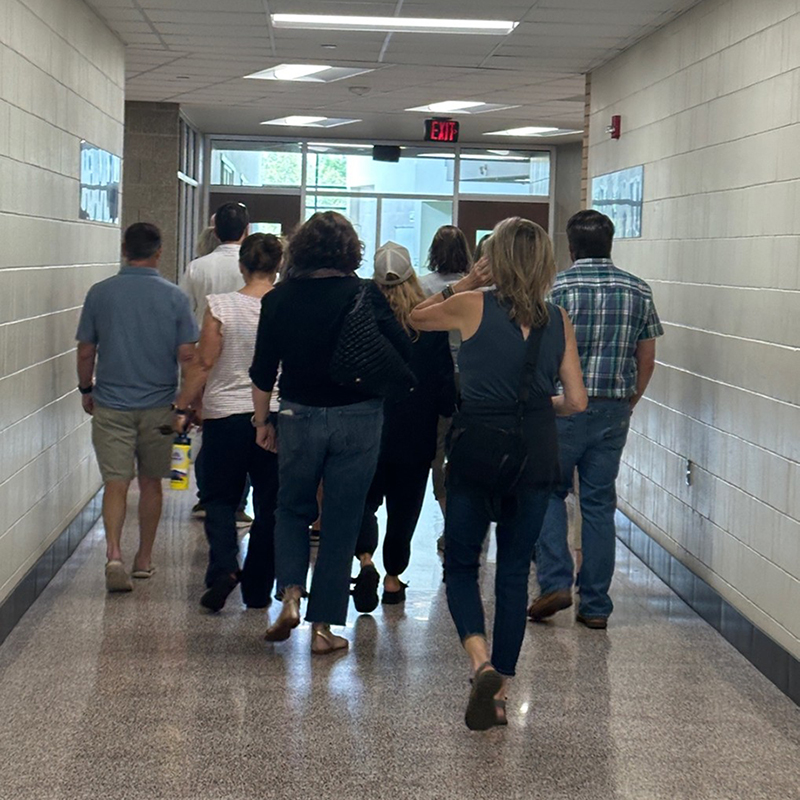
To see what had been updated since 1985, I visited my old high school and went on a tour. My tour group had about 15 folks. First off, I want to say Edina High School looks fabulous. The facilities are top notch. The views from the cafeteria with more light filtering in – gorgeous. It is a beautiful place to go to high school.
The tour guides asked all attendees of our tour group to gather in a circle, to state our names, and to share either one thing we remember from EHS or our favorite thing about our time there. One classmate recalled with fondness all the sports she played (soccer, especially). The next person chimed in with more fondness about sports she had played (skiing, especially). When it got to me, with a smile, I recalled being in the concert choir.
And then things moved on. The guy next to me recalled his favorite thing was ‘graduating.’ The guy next to him basically said ‘Ditto.’ Then the next woman said “What I remember was that I was naughty.” ‘Ditto’ from the next. And ‘Ditto’ again said the third woman. “I was naughty with them.” There were awkward giggles. There was a bit of silence. And the tour continued. Gulp.
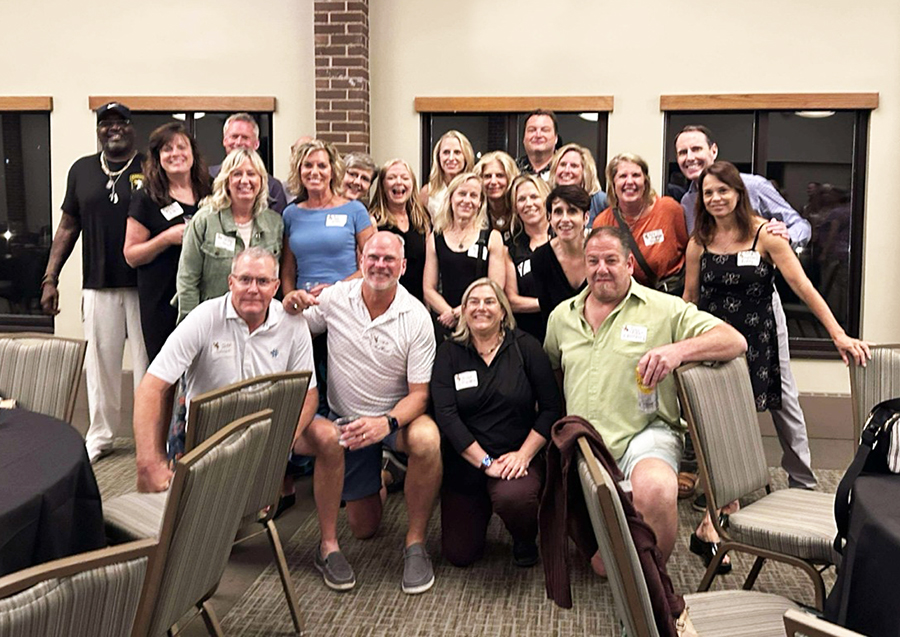
Picture of the Creek Valley Elementary Cohort attending the 40th HS Reunion of Edina High, Edina, Minnesota.
Harriet Lerner, one of my cognitive crushes, is a psychologist based out of Kansas. Her quote from her book, The Dance of Connection, graces my homepage, has a prominent spot at the start of my workshop slides, and really hits home for me given my tour experience 40 years out from my high school graduation.
She wrote, “Our conversations invent us. Through our speech and our silence, we become smaller or larger selves. Through our speech and our silence, we diminish or enhance the other person, and we narrow or expand the possibilities between us. How we use our voice determines the quality of our relationships, who we are in the world, and what the world can be and might become. Clearly, a lot is at stake here.”
As a teacher, I heard those final comments from my classmates (I remember I graduated. I remember I was naughty) and recall how those memories still sting my ears, not even said about me. Some 40 years out from those ‘invent us’ moments, I could talk about the need for trauma informed instruction, and having an essential understanding of the adverse childhood experience indicators (ACE).
Yet what I felt in that moment was a strong reminder to remember how comments we say to someone in their childhood could invent them, and can determine who they are in the world. We must remember how important it is to take the opportunity to build someone up, offer a compliment, and acknowledge their strengths.
Ask yourself:
- In my conversations have I worked on my communications, so I try to help someone see their ‘larger self’?
- In my conversations have I worked to not diminish but to enhance the other person?
- In my conversations have I worked to expand the possibilities between myself and another or have I diminished them and thus the possibilities between us?
Many of us might still be carrying around an identity ‘invented’ for us ages ago. We possibly grew smaller as a result. And, we have agency and choice to say something different, to notice someone in a positive way. “How we use our voice determines the quality of our relationships, who we are in the world, and what the world can be and might become. Clearly, a lot is at stake here.” Join me.
Questions, comments, or suggestions? Feel free to email me at jennifer@jenniferabrams.com.
Cool Resources
Ferocious Warmth: School Leaders Who Inspire and Transform by Tracey Ezard. “In this book, Tracey Ezard unpacks the elements of the Ferocious Warmth leader. Through stories, discussions with leaders in the field and research, she uncovers a new approach that will help education leaders everywhere find the sweet spot of leading results and relationships, strategy and culture, task and people.”
The Empathy Advantage: Leading the Empowered Workforce by Heather E McGowan and Chris Shipley. “The Empathy Advantage offers advice on how to lead a complex, diverse, and multi-generational workforce to out-perform your competition. This book will inspire you to:
- Rethink Your Workforce: You’ll gain new insights into today’s empowered workforce and how best to tap their intrinsic motivations.
- Rethink Your Organization: You’ll learn how to reorganize work to become resilient in continuous change.
- Rethink Your Leadership: You’ll discover superpowers and unleash your Empath Advantage.”
Developing Servant Leaders at Scale: How to Do It, and Why It Matters by Max Klau. “Servant leadership is both an ancient concept and a contemporary field of study and practice. The notion that true power and greatness comes from living one’s life in service to others can be found in all the major religions. The modern incarnation of this concept can be traced to an essay published in 1970 by Robert K. Greenleaf called “The Servant as Leader.”
Space is Not Empty: How Hidden Fields Are Shaping Your Life and Our World by Alan Briskin and Mary V. Galinas. “Have you ever walked into a room and known immediately that something was off? Maybe your skin tingled or your stomach clenched, maybe you noticed how eyes were averted or chatter was strained. Or maybe the opposite was true and you were walking into a place of safety and comfort, where your breathing came more easily, your heart rate calmed, and your tension melted away. In this groundbreaking interdisciplinary book, Alan Briskin and Mary V. Gelinas weave together a combined eighty years of experience in social psychology, systems thinking, and contemplative practices to explain how fields influence us physically, emotionally, and intuitively—often without our conscious awareness.”